Medically reviewed by Dr. Maryam Jahanshahi, ND
Losing weight well is not just about the number on the scale, it is about what you lose. Fast or unsupported weight loss can strip away muscle and leave loose skin. You protect your body composition by losing weight gradually, eating enough protein, doing regular strength training, and looking after your skin along the way. It is crucial to Protect Muscle & Skin During Weight Loss.
When most people set out to lose weight, they watch one number: the scale. But two people can lose the exact same number of pounds and end up in very different places. One keeps their strength, their shape, and their energy. The other loses muscle, feels weaker, and is left with skin that does not quite fit.
The difference is body composition, the balance of fat, muscle, and other tissue that makes up your body. Supporting it is what separates weight loss that leaves you healthier from weight loss that quietly costs you something.
This matters more than ever now that medical weight loss is common and effective. When the weight can come off quickly, protecting muscle and skin has to be a deliberate part of the plan, not an afterthought. Here is how to do it.
To effectively Protect Muscle & Skin During Weight Loss, incorporate these strategies into your routine.
Key takeaways
- The goal is to lose fat while keeping muscle, not simply to lower the number on the scale.
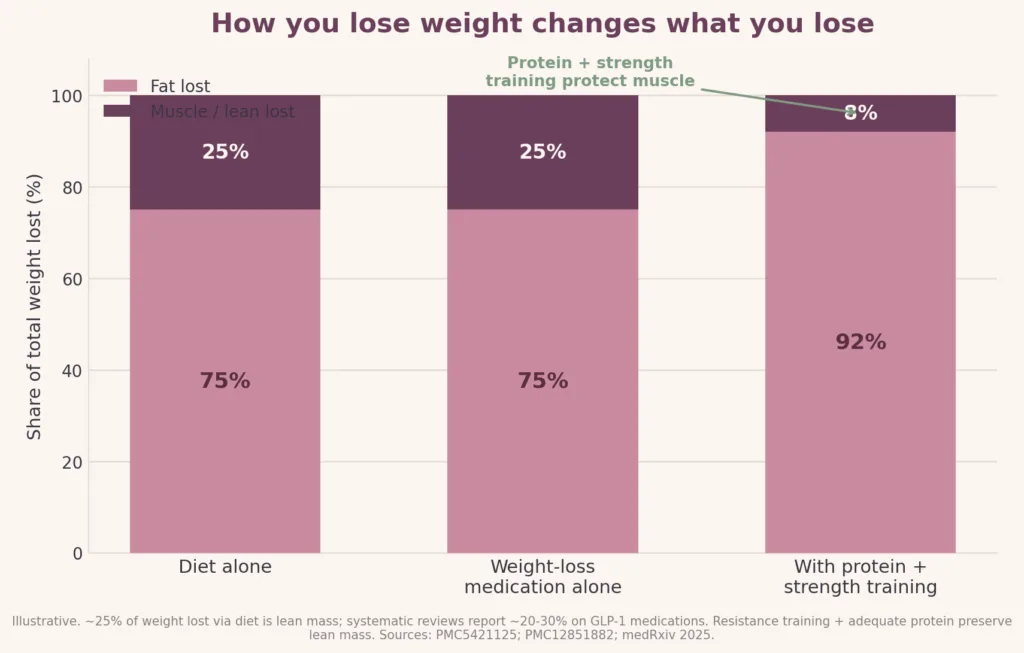
- Roughly a quarter of weight lost through dieting alone can come from muscle and other lean tissue.
- Protein and strength training are the two proven levers that protect muscle during weight loss.
- Loose skin depends on how much and how fast you lose, plus age, genetics, sun exposure, and smoking.
- There is no way to guarantee no loose skin, but gradual loss and muscle building reduce its severity.
- If you are using weight-loss medication, a muscle-preservation plan should be part of it from day one.
What is body composition, and why does it matter more than the scale?
Your body weight is made up of different tissues: fat, muscle, bone, water, and organs. Body composition is the ratio between them, and it tells you far more about your health than weight alone.
Muscle is the tissue you most want to protect. It is metabolically active, meaning it burns energy even at rest, so keeping it helps maintain your resting metabolic rate (the calories your body uses just to keep you alive). Muscle also drives your strength, balance, and independence as you age. Two people at the same weight can have very different amounts of muscle, and the one with more is usually healthier and metabolically better off.
So when we talk about protecting your body composition during weight loss, we mean this: lose the fat, keep the muscle.
Why do you lose muscle when you lose weight?
Here is the uncomfortable truth most weight-loss advice skips. When you lose weight, some of what you lose is almost always muscle.
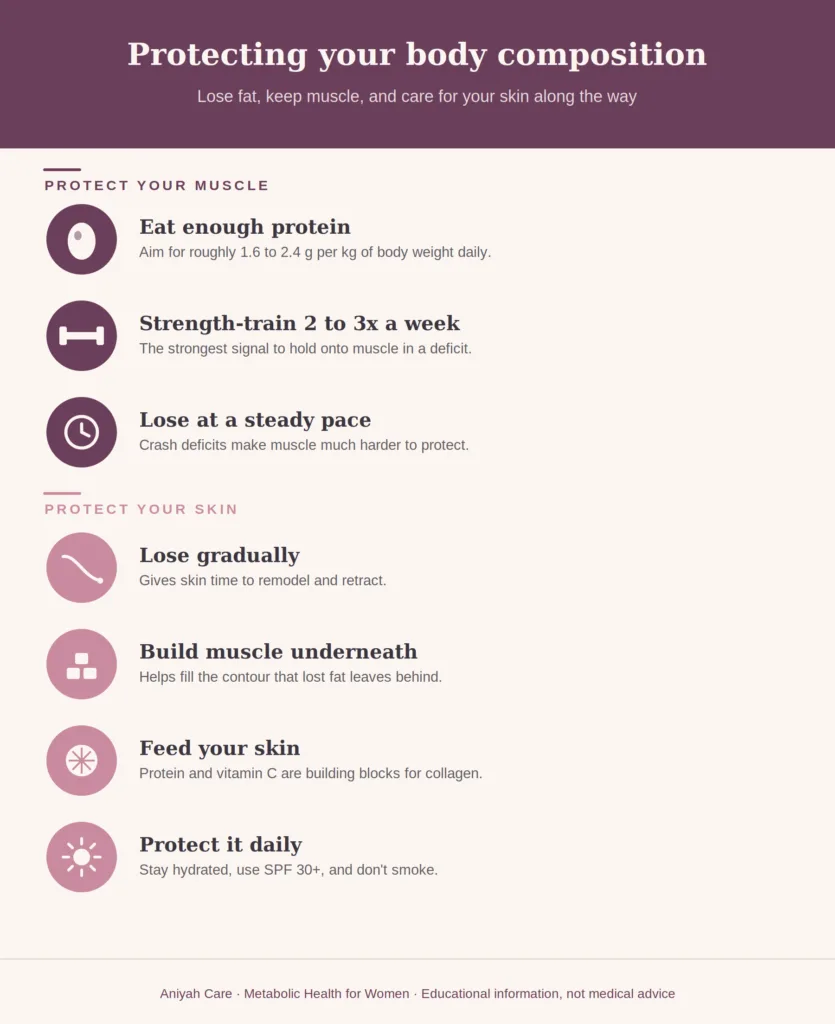
With dieting alone, research suggests that about 25 percent of the weight you lose can come from fat-free mass, which includes muscle. In other words, for every four pounds lost, roughly one can be lean tissue rather than fat. That is the default your body reaches for when energy is scarce and nothing signals it to hold onto muscle.
This is not a reason to avoid losing weight. It is a reason to lose it well, because the muscle loss is largely preventable. The two signals that tell your body to protect muscle are eating enough protein and using your muscles through resistance training. Give it those signals, and the picture changes dramatically.
How to preserve muscle during weight loss?
Two levers do most of the work, and they work best together.
1. Eat enough protein: Protein is the raw material your body uses to maintain muscle. During weight loss, research supports a higher protein intake, in the range of roughly 1.6 to 2.4 grams per kilogram of body weight per day, to protect lean mass, especially when you are active. That is meaningfully more than most people eat by default. Spreading it across meals, rather than loading it all at dinner, helps your body use it. If you have kidney disease or another condition, your protein target needs to be individualized with a clinician, so this is a good thing to raise at a consultation.
2. Do resistance training: Strength training is the single most powerful signal you can send to preserve muscle in a calorie deficit. Studies consistently show that resistance training attenuates, and sometimes fully prevents, the muscle loss that would otherwise come with weight loss, and it does far more to protect lean tissue than cardio alone. You do not need to become a bodybuilder. Two to three sessions a week working the major muscle groups, with gradually increasing resistance, is enough to shift the odds.
3. Do not lose weight faster than you need to: The more aggressive the calorie deficit, the harder it is for protein and training to keep up. A steadier pace gives your body time to lose fat preferentially and hold onto muscle.
Put simply: protein gives your body the material, resistance training gives it the reason, and a sensible pace gives it the time.
Why weight loss can leave loose skin?
The other half of body composition is the part you can see in the mirror: your skin.
Your skin stays firm thanks to two proteins in its deeper layer, collagen (which gives structure and strength) and elastin (which gives it the ability to stretch and bounce back). When you gain weight, your skin stretches to accommodate it. When you lose that weight, the skin needs to retract. Sometimes it does not fully manage it.
Whether you are left with loose skin depends on several things:
- How much weight you lose: Larger losses, generally above about 50 pounds, are more likely to leave excess skin.
- How fast you lose it: Rapid loss does not give skin time to remodel and contract.
- Your age: Collagen and elastin production decline with age, so older skin is less able to bounce back.
- How long the skin was stretched: Skin kept stretched for years can lose some of its ability to retract.
- Genetics, sun exposure, and smoking: Your genes set your baseline, while UV damage and smoking actively break down collagen and elastin.
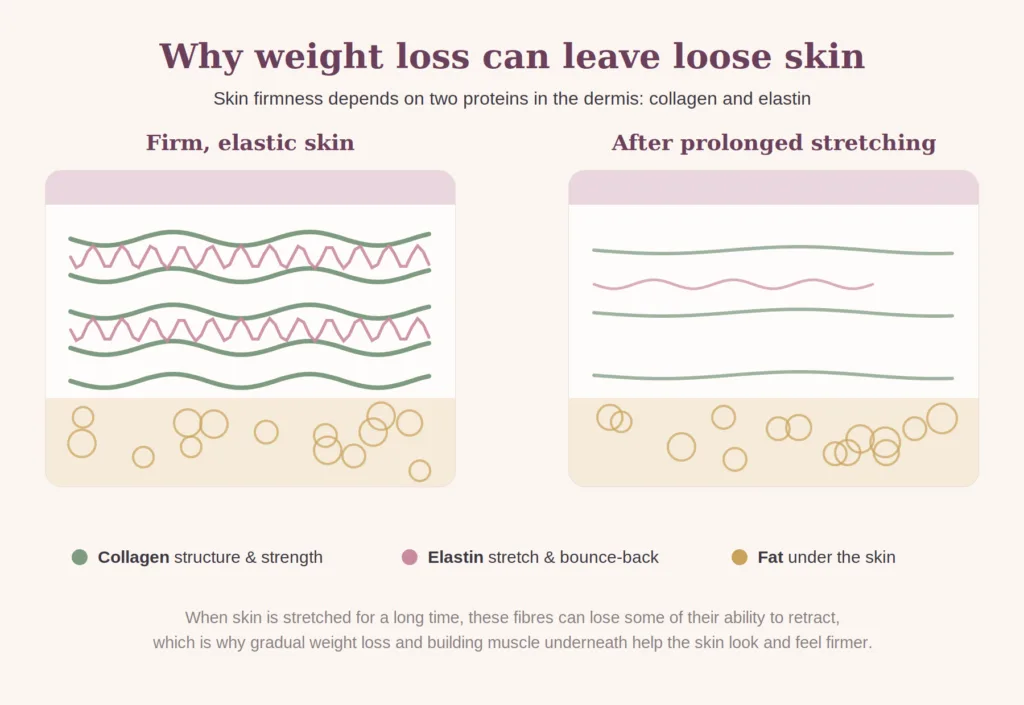
An honest note: if you lose a large amount of weight, some skin laxity is likely, and no routine fully prevents it. But the severity varies a lot, and several things genuinely help.
How to protect your skin during weight loss?
Most of what protects your skin is the same thing that protects your muscle, which is one reason a well-designed program helps on both fronts at once.
- Lose weight gradually: Steady loss gives skin the best chance to keep pace and remodel.
- Build muscle: This is the overlap. Muscle helps fill out the contour that fat leaves behind, so the skin has more underneath it and looks and feels firmer.
- Get enough protein and vitamin C: Both are building blocks for the collagen your skin depends on.
- Stay hydrated: Well-hydrated skin maintains its elasticity better.
- Protect against sun and skip smoking: Daily broad-spectrum SPF 30 or higher, and not smoking, protect the collagen and elastin you already have.
Set expectations kindly, too. How much loose skin bothers a person does not always match how much there is, and comfort, function, and body image all play a part. For significant excess skin that does not improve with time, options range from non-surgical skin-tightening treatments to surgical body contouring, and a clinician can help you understand what is realistic for your situation.
What about collagen supplements? They are popular, and there is some early evidence that collagen peptides taken with vitamin C may modestly support skin elasticity. But the evidence is limited, and a supplement is not a substitute for gradual loss, protein, and muscle. Treat it as a possible small add-on, not a fix.
A note if you are using weight-loss medication
Medical weight loss has changed what is possible, and it has also made body composition support more important, not less.
Recent evidence is a useful example. Systematic reviews of GLP-1 receptor agonists, a class of medications now widely used in weight management, have found that roughly 20 to 30 percent of the weight lost can come from lean mass, including muscle. That is not a reason to avoid these medications, which can be appropriate and beneficial when medically indicated. It simply means that muscle preservation should be built into any medically supervised program from the very first week.
If you are on, or considering, a medically supervised weight-loss program, that muscle-protecting plan (enough protein, regular resistance training, and monitoring of how you are losing weight, not just how much) is exactly what to ask your care team about.
Who benefits most from a body-composition-first approach?
This approach is worth prioritizing if you are:
- Losing a significant amount of weight, or losing it quickly
- Using or considering weight-loss medication
- Over 40, when muscle and collagen both decline more readily
- Going through perimenopause or menopause, when muscle loss accelerates
- Someone who has lost and regained weight before and wants a more durable result this time
When to seek professional support?
Losing weight in a way that protects your muscle and skin is a lot easier with a plan built for your body than with generic advice. It is worth working with a healthcare professional or dietitian if you want help setting a realistic protein target, building a strength routine that fits your life, choosing a safe rate of loss, or deciding whether a medically supervised program is right for you.
Frequently asked questions
The bottom line
Weight loss is not just about losing. It is about keeping the things that make you strong and healthy while the fat comes off. Protect your muscles with protein and strength training, protect your skin by losing gradually and caring for it along the way, and measure your progress by how your body is changing, not only by the number on the scale.
Talk to our team. Aniyah Care builds body-composition-focused weight-management plans for women in Ajax and across Durham Region, so you lose fat while protecting your muscle and skin. Book a metabolic health consultation to build a plan around your body.
References