Medically Reviewed by Registered Dietitian Melodi Hajipour Fard, MSc, RD, CDE
A registered dietitian (RD) is a regulated health professional who provides individualized, evidence-based nutrition therapy. In medical weight management, an RD builds an eating plan around your body, health history, and goals, supports lasting behaviour change, and protects your nutrition and muscle while you lose weight. Canada’s national obesity guidelines recommend dietitian-provided nutrition therapy at their highest level of evidence. If you’re looking for support, consider a Registered Dietitian for Weight Loss in Ajax.
If you have decided to take weight management seriously, you have probably run into a wall of conflicting advice. One app says cut carbs, another says count calories, a friend swears by fasting, and social media is full of confident strangers selling plans. It is exhausting, and most of it is not built for your body.
This is exactly the gap a registered dietitian fills. Not another diet, but a qualified professional who translates the science into a plan that fits your life, your health, and your goals. Here is what an RD really does in medical weight management, what the evidence says about whether it works, and how to find one in Ajax and across Durham Region.
Finding a Registered Dietitian for Weight Loss in Ajax can make a significant difference in your journey.
Key takeaways
- A registered dietitian (RD) is a regulated health professional; in Ontario the title is protected by law, while nutritionist is not.
- Canada’s national obesity guidelines recommend RD-provided nutrition therapy at their highest evidence level to improve weight and related health markers.
- A dietitian does far more than hand you a meal plan; they assess, personalize, coach behaviour change, and protect your nutrition and muscle.
- In a medical weight loss program, the dietitian works alongside your physician or nurse practitioner, not in place of them.
- Dietitian services are generally not covered by OHIP, but they are often covered by extended health (paramedical) benefits.
What is a registered dietitian, and how is it different from a nutritionist?
This is the most important thing to understand before you trust anyone with your nutrition, and it surprises most people.
In Ontario, registered dietitian and dietitian are titles protected by law under the Dietetics Act. Registered dietitians are the only regulated nutrition professionals in the province, and they are accountable to the College of Dietitians of Ontario for safe, ethical, evidence-based care, just like physicians and nurses are accountable to their colleges.
To use the RD title, a person must complete an accredited four-year university degree in nutrition, a supervised practical internship, and pass the national Canadian Dietetic Registration Examination. They must then keep their knowledge current through an ongoing quality assurance program.
By contrast, nutritionist is not a protected title in Ontario. Anyone can legally call themselves a nutritionist and offer nutrition advice, regardless of their training, and there is no regulatory college to hold them accountable. That does not mean every nutritionist is unqualified, but it does mean the title alone tells you nothing about their education. Research in Ontario has found that most of the public does not realize this difference, and that people’s experiences tend to be more positive when their nutrition advice comes from a registered dietitian.
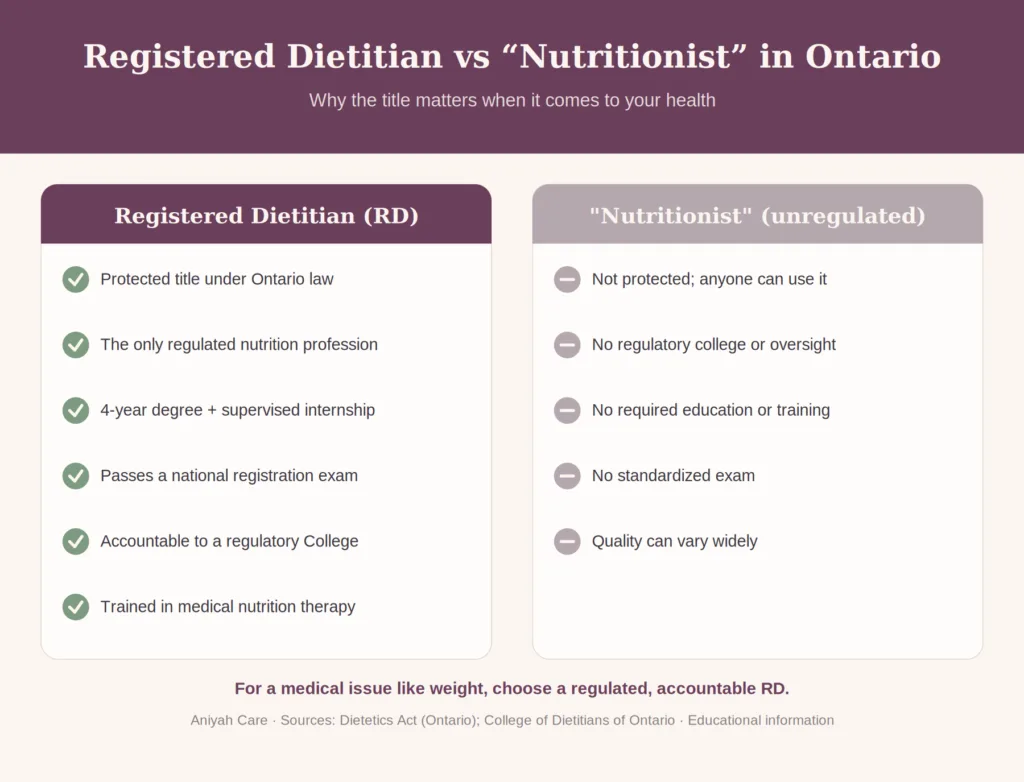
The practical takeaway: for a medical issue like weight, where the wrong advice can do real harm, the RD credential is your assurance of regulated, accountable, evidence-based care.
What does a dietitian do in medical weight management?
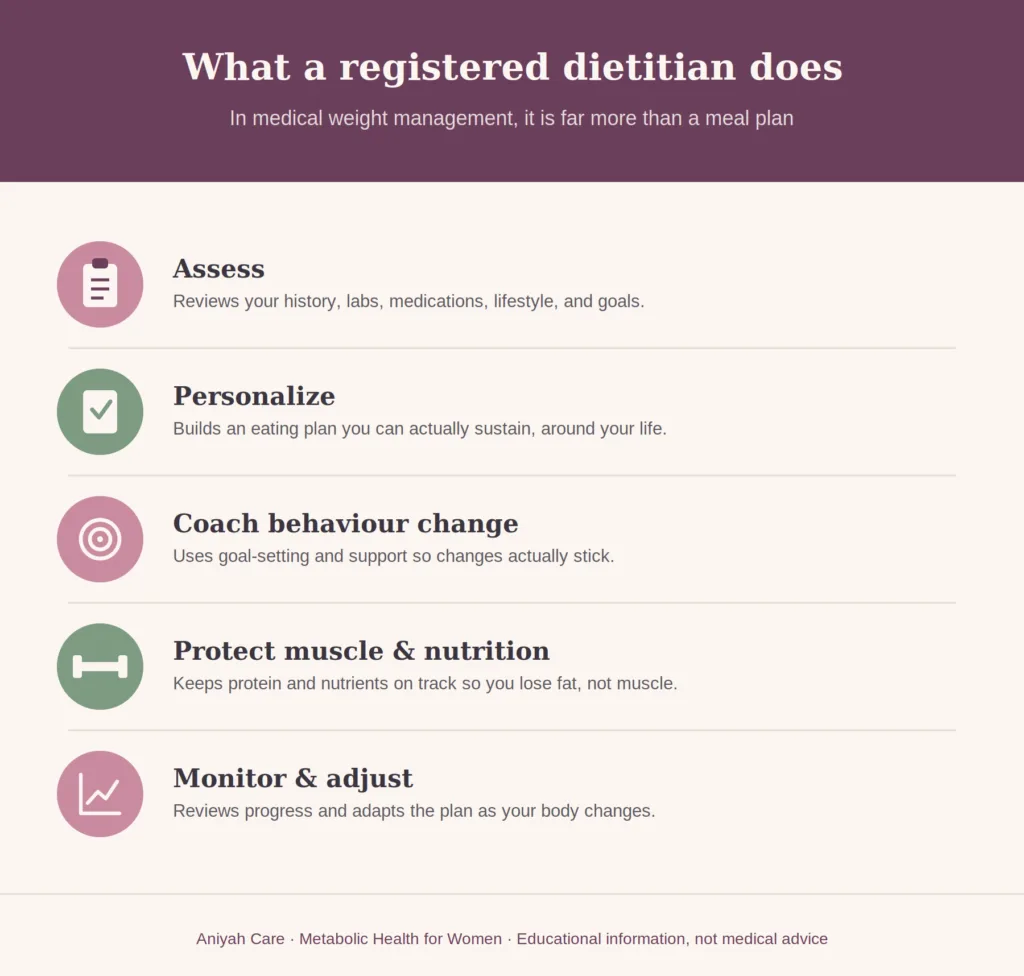
A good dietitian does far more than print a meal plan. Their work usually includes:
- A full nutrition assessment: They look at your eating patterns, medical history, medications, lab results, lifestyle, culture, budget, and relationship with food, not just your weight.
- An individualized plan: There is no single best diet. The best approach is the one you can actually sustain while meeting your health targets, whether that is blood sugar, cholesterol, blood pressure, or weight. A dietitian builds that around you.
- Behaviour change support: This is the part most diets skip. Dietitians use techniques like goal-setting, self-monitoring, and motivational interviewing to help changes actually stick, rather than collapsing after three weeks.
- Protecting your nutrition and muscle: Losing weight the wrong way can cost you muscle and leave you under-nourished. A dietitian makes sure you get enough protein and nutrients to lose fat while protecting lean tissue. Related: [protecting muscle and skin health during weight loss]
- Ongoing monitoring and adjustment: Your plan is not static. As your body, schedule, and results change, so does the plan.
Crucially, a dietitian also helps you separate evidence from noise, which is worth a great deal when the internet is full of confident, unqualified advice.
Does seeing a dietitian actually help you lose weight?
Yes, and the evidence for it is strong.
Canada’s Adult Obesity Clinical Practice Guidelines recommend that adults living with obesity receive individualized medical nutrition therapy provided by a registered dietitian, where available, to improve body weight, waist circumference, blood sugar control, cholesterol, and blood pressure. This carries their highest rating for evidence quality, which is not something guideline authors hand out lightly.
International evidence agrees. The Academy of Nutrition and Dietetics reviewed the research and concluded that dietitian-delivered nutrition therapy, paired with behaviour-change support, improves both weight and cardiometabolic outcomes for adults with overweight and obesity.
One honest note worth making: success is not only about the number on the scale. Good nutrition care also improves energy, blood markers, and your relationship with food, and those wins matter even when the scale moves slowly.
How a dietitian fits into a medical weight loss program
The word medical in medical weight management matters. It means weight is treated as a health condition, with a team, rather than a willpower contest you face alone.
In that model, the dietitian is one part of a coordinated team. Your physician or nurse practitioner handles medical assessment, investigations, and, where appropriate, prescribing. The dietitian handles the nutrition strategy that everything else depends on. The two work together, not in isolation.
This teamwork matters even more when medication is part of the plan. When someone is using an obesity medication, such as a GLP-1 receptor agonist, appetite often drops sharply. That can make it surprisingly easy to under-eat protein and lose muscle along with fat. A dietitian’s job is to make sure the nutrition keeps pace, so the weight you lose is the weight you want to lose.
In other words, medication can change appetite, but it does not build a healthy eating pattern. That is the dietitian’s role, and it is a big part of what makes results last.
What to expect when you work with a dietitian
For most people, the process looks something like this:
- An initial assessment: A longer first appointment where the dietitian gets to know your history, habits, health, and goals in detail.
- A personalized plan: Practical, realistic, and built around your life rather than an ideal that ignores it.
- Follow-up visits: Regular check-ins to review progress, troubleshoot obstacles, and adjust the plan as you go.
If this is part of a broader metabolic program, your first visit may be combined with a medical assessment.
Is a dietitian covered by OHIP in Ontario?
This is one of the most common practical questions, so here is the honest answer.
Private dietitian services are generally not covered by OHIP. You may access an RD without charge in some settings, such as certain hospital programs, Family Health Teams, or Diabetes Education Programs, but private clinic visits usually are not covered by OHIP.
The good news is that many extended health benefit plans do cover registered dietitian services, often listed under “paramedical” practitioners. If you have workplace or private insurance, it is worth checking your plan for the annual coverage amount, any per-visit limits, and whether a physician referral is required.
Finding a dietitian for weight loss in Ajax and Durham Region
If you are searching for a weight loss dietitian in Ajax, Pickering, Whitby, Oshawa, or the wider Durham Region, a few things are worth looking for:
- The RD credential: Confirm the person is a registered dietitian, not only a nutritionist.
- Experience in weight and metabolic health: Obesity management is a specialized area, so look for relevant experience.
- A team-based, medical approach: Nutrition works best when it is coordinated with your medical care rather than sitting off to the side.
- A respectful, individualized style: The right dietitian works with you, not at you.
At Aniyah Care in Ajax, registered dietitian care is built into our metabolic health programs, so your nutrition plan is coordinated with your medical assessment from the start. We work with women across Ajax and Durham Region who want a plan built around their body rather than a generic diet.
Who benefits most from working with a dietitian?
Dietitian support is especially valuable if you:
- Have tried multiple diets that did not lead to lasting change
- Are you managing a condition alongside your weight, such as prediabetes, diabetes, high cholesterol, or high blood pressure
- Are you using or considering weight-loss medication and want to protect your muscle and nutrition
- Are you navigating perimenopause or menopause, when nutrition needs shift
- Simply want evidence-based guidance instead of internet guesswork
When to seek support
If weight is affecting your health or quality of life, or you feel stuck despite real effort, it is reasonable to reach out to a registered dietitian or a medical weight management program. You do not need to have failed at anything first, and you do not need to wait until things feel urgent.
Frequently asked questions
The bottom line
A registered dietitian is not another diet. They are a regulated, qualified professional who builds a nutrition plan around your body, supports the changes that make it last, and protects your health and muscle along the way. For anyone serious about managing their weight, especially alongside medical care, that support is one of the most evidence-backed steps you can take.
Talk to our team. Aniyah Care offers registered-dietitian-supported metabolic health and weight management for women in Ajax and across Durham Region. Book a consultation to build a nutrition plan around your body and your goals.