
Need help booking an appointment? Call us at (905) 487-4411 or email info@aniyahcare.com
Pelvic floor dysfunction isn’t always about visible leaks. Pressure, heaviness, core instability, and discomfort are real symptoms of real, treatable conditions.
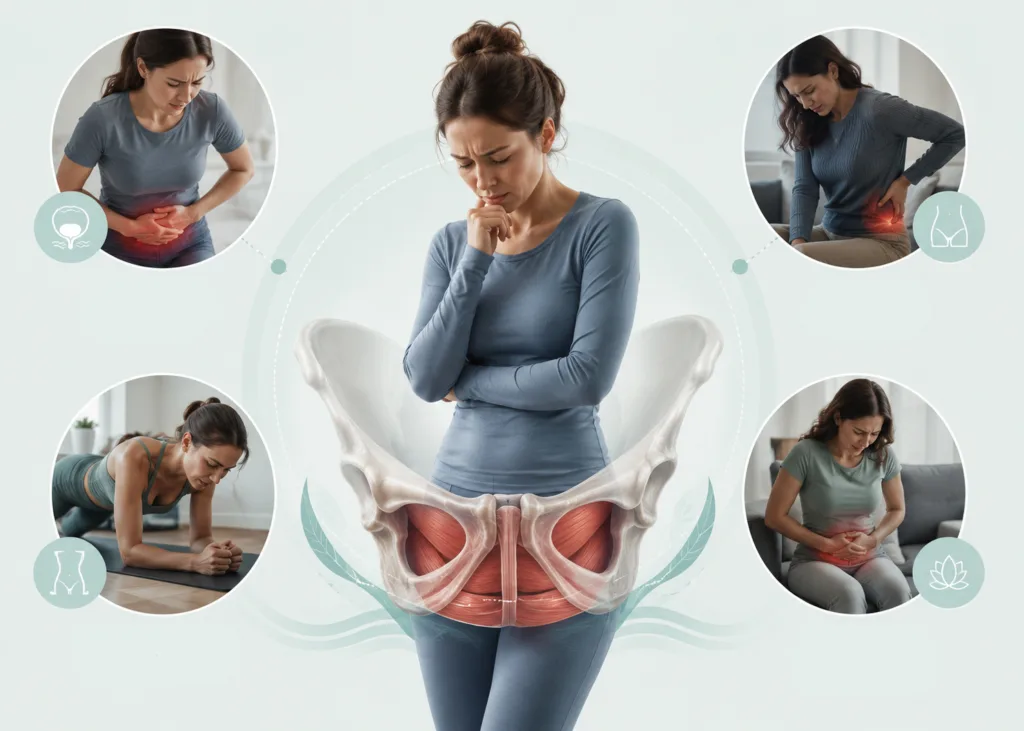
The pelvic floor is a complex group of muscles, ligaments, and connective tissue that forms the base of the pelvis. These structures are responsible for far more than bladder control:
Holds the bladder, bowel, and uterus (or prostate) against gravity and intra-abdominal pressure during daily movement.
Manages the opening and closing of the bladder and bowel outlets — coordinating continence and healthy voiding.
Anchors the pelvis, hips, and lower spine as a critical part of the core — working with the diaphragm and deep abdominal muscles.
When pelvic floor muscles are weakened, overactive, or poorly coordinated, any or all of these functions can be disrupted — producing symptoms that range from incontinence and prolapse to chronic pain, core instability, and intimacy concerns.
Pelvic floor dysfunction is highly treatable when properly assessed. Every care plan at Aniyah Care begins with understanding your individual presentation — not a generic protocol applied to everyone.
FMS rebuilds pelvic muscle volume, improves neuromuscular coordination, and re-establishes the brain-muscle connection.
Comprehensive assessment + personalised program tailored to your specific dysfunction.
You’ve put up with this long enough. Let’s get you the support you need safely, privately, and without judgment.
” I kept telling my GP something felt off, but no one could explain it clearly. The assessment at Aniyah Care was the first time someone actually took the time to figure out what was going on — and then do something about it. “
EXCELLENTTrustindex verifies that the original source of the review is Google. Dr. Ali Mirzazadeh is attentive, interested, understanding and supportive. He provided knowledge, tools and suggestions to improve my physical and mental health. I wasn’t sure what to expect from my appointment with Dr. Ali, as I’ve never been to a Naturopathic doctor, but he surely exceeded my expectations.Posted on GoogleTrustindex verifies that the original source of the review is Google. I cannot thank the Aniyah and HMCC staff enough for their care, kindness and therapeutic treatments I have had. They are an amazing health care team and they truly have your best interest at heart. So lucky to have found a place that treats you like family and puts your health first. Shout out to Pauline, Renee, Krystle, Dr. Ku and Dr. Wynd and team!!Posted on GoogleTrustindex verifies that the original source of the review is Google. Kavita Thakkar is very kind and helpful. She goes above and beyond to make sure all her patients concerns are heard and understood. Very knowledgeable, great Physiotherapist.Posted on GoogleTrustindex verifies that the original source of the review is Google. Pauline, along with the rest of the team are caring, compassionate, professional, and efficient. They alway remember you by name and treat you with respect; no matter the issue. I highly recommend them for all their services. They are true professionals, and the treatments have made a big difference in my wellbeing.Posted on GoogleTrustindex verifies that the original source of the review is Google. Very professional and knowledgeable , The Staff are awesome they take the time to explain everything and make you feel very comfortable I highly recommendPosted on GoogleTrustindex verifies that the original source of the review is Google. Love the staff they are truly Amzing ❤️ and the treatment works AmzingPosted on GoogleTrustindex verifies that the original source of the review is Google. kind,humble,professional,love her patients always positivePosted on GoogleTrustindex verifies that the original source of the review is Google. My name is lloyd Sutherland Today i went in to see DR MOHAMMAD ALI MIRAZADEH, this wasnt my first visit with him but my second or third visit was wonderful he explain in full detail everything to me putting my mind at ease i feel like he had my best health intrest at heart ,he is a wonderful and caring doctor he makes me feel like i was a family members, i cant wait to go back to see him again ,i have seen doctors in the past and i never feel the way like hiw DR mohammad ali makes me feel , a matter of fact i have met most of the other staff also and they are amazing staff, the takeway is that they all care about there patients.Posted on GoogleTrustindex verifies that the original source of the review is Google. The Staff always treat you like a VIP. Coming to Aniya is always is a highlight to my day!!
Not sure which condition applies to you? Our conditions pages explain each type of pelvic floor dysfunction in plain, compassionate language — including what causes it and what treatment may help.

Postpartum pelvic floor dysfunction is one of the most common.

Urge incontinence and overactive bladder are among the most disruptive.

Pelvic floor dysfunction isn’t always about visible leaks. Pressure, heaviness.

Stress urinary incontinence is one of the most common and most treatable forms of bladder leakage

Lorem ipsum dolor sit amet, consectetur adipiscing elit.

Lorem ipsum dolor sit amet, consectetur adipiscing elit.
Something not answered here? Call us directly — our team is always happy to talk things through.
Not necessarily. Pelvic floor dysfunction is a broader category that includes incontinence, but also encompasses prolapse, pelvic pain, core instability, intimacy concerns, and bowel issues. Many people with pelvic floor dysfunction have no obvious leakage at all.
Sometimes mild cases improve, but moderate to significant dysfunction typically does not self-resolve. Without treatment, symptoms often gradually worsen — particularly around life transitions like childbirth, perimenopause, and menopause.
At Aniyah Care, assessment begins with a comprehensive consultation to understand your symptom pattern and health history. Physiotherapy assessment may include functional movement screening and, where appropriate and consented, internal assessment of pelvic floor function.
Our comprehensive pelvic health assessment gives you real answers — and a real plan. Book your free consultation in Ajax today.
Located at 555 Kingston Rd West, Ajax — we’re one of the most accessible integrative clinics in the region. Most patients drive 20 minutes or less.

Our goal is to help people live healthier lives through wellness solutions that are science-based and designed to deliver long-lasting, positive results.